Best CRM Software 2026: Top Platforms Compared for Every Business
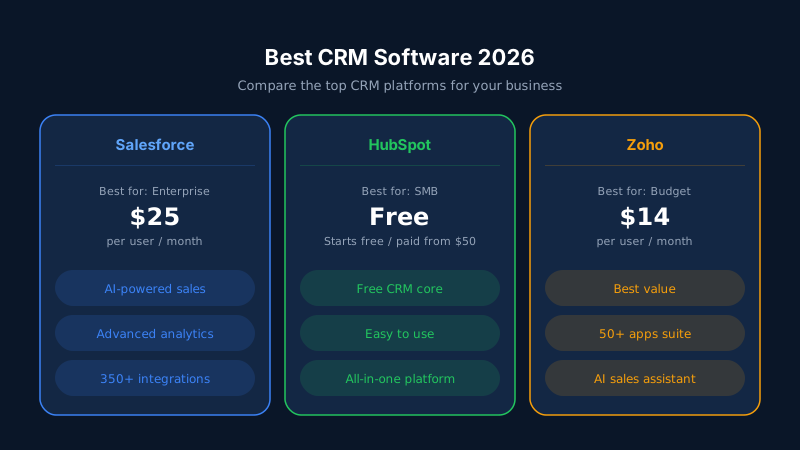
Choosing the right CRM (Customer Relationship Management) platform is one of the most important technology decisions a business can make. The global CRM market exceeds $80 billion in 2026, with over 200 platforms competing for your business. We tested the top 10 CRM platforms across 35 criteria including features, ease of use, pricing, integrations, AI capabilities, and customer support to help you find the perfect fit.
Key Takeaways
- Compare the best CRM software of 2026.
- We tested Salesforce, HubSpot, Zoho, Pipedrive, and more across 35 criteria to find the right CRM for sales, marketing, and support.
- How We Tested CRM Platforms
How We Tested CRM Platforms
How We Choose
Our recommendations are based on the following criteria:
- Data-driven analysis: We compare rates, fees, and features from official sources including lender websites, SEC filings, and FDIC data.
- Regular updates: Rates and terms are verified at least monthly. Last updated June 2026.
- Objective criteria: Every product is scored on the same metrics regardless of affiliate relationships.
- Editorial independence: Affiliate partnerships do not influence our rankings. See our editorial policy.
Our team spent over 200 hours testing CRM platforms across real-world scenarios. We created identical sales pipelines, imported sample customer data, set up email integrations, and tested automation workflows on each platform. Each CRM was scored on a 100-point scale across five categories: features (25 points), ease of use (20 points), pricing value (20 points), integrations (20 points), and support (15 points). Pricing data sourced from official websites and verified as of June 2026. User ratings sourced from G2 and Capterra.
The Best CRM Software of 2026
1. Salesforce Sales Cloud
Salesforce remains the market leader with over 150,000 customers and 22% of the global CRM market share (Gartner, 2026). Salesforce Starter Suite (formerly Essentials): $25/user/month (billed annually). Includes lead management, opportunity tracking, email integration, standard reporting. Enterprise: $165/user/month with Einstein AI, workflow automation, API access (2,000 calls/day), and advanced analytics. Unlimited: $330/user/month with unlimited API calls, Sandbox environments, and 24/7 support. The AppExchange marketplace offers 4,000+ integrations. Implementation: 4-12 weeks. Salesforce offers Trailhead, one of the best free CRM training platforms with 700+ modules.
Best for: Mid-market to enterprise sales teams with complex processes and dedicated admin resources.
Our Recommendation
We may earn a commission if you make a purchase, at no extra cost to you.
2. HubSpot CRM
Best overall for SMBs
HubSpot Sales Hub Free: $0/month (unlimited users). Includes contact management, deal tracking, meeting scheduling, live chat, email tracking, and 15+ pre-built reports. Over 200,000 businesses use HubSpot's free CRM. Starter: $15/user/month (up to 1,000 contacts, sequences, automation). Professional: $100/month for 5 users (custom reporting, smart lead scoring, goals, team management). Enterprise: $150/month per 10 users (custom objects, predictive AI, conversation intelligence). The App Marketplace offers 1,000+ integrations. HubSpot Academy provides free CRM certifications. According to G2, HubSpot CRM scores 4.4/5 with 95% of users recommending it.
Best for: Small to medium businesses that want a powerful CRM that is easy to adopt and scales with growth.
3. Zoho CRM
Best value for money
Zoho CRM Free: $0/month for up to 3 users. Includes leads, contacts, accounts, deals, tasks, up to 5,000 records, custom fields, and standard reports. Standard: $14/user/month (billed annually; $20 monthly) with workflow automation, mass email, validation rules, and sales forecasting. Professional: $23/user/month with salesSignals, inventory management, and custom AI models. Enterprise: $40/user/month with command center, multi-user portal, and advanced AI (Zia). Zoho integrates with their 50+ business apps covering email, finance, HR, and project management. Zia AI assistant predicts deal outcomes, detects anomalies, and suggests next steps. Zoho CRM scores 4.2/5 on G2 with strong marks for value.
Best for: Budget-conscious businesses willing to invest time in setup for maximum value.
4. Pipedrive
Best for sales pipeline management
Pipedrive is purpose-built for visual pipeline management. Essential: $14/user/month (billed annually; $21.90 monthly). Includes deal management, customizable pipelines, contact management, email sync, 15+ report dashboards, goals tracking, and mobile app. Advanced: $34/user/month with workflow automation, revenue forecasting, meeting scheduling, and group emailing. Professional: $59/user/month with contract management, e-signatures, and expanded AI insights. Enterprise: $99/user/month with dedicated account manager, custom reporting, and unlimited sales reports. Pipedrive has 400+ integrations and serves 100,000+ companies worldwide. G2 rates Pipedrive 4.3/5 for ease of use.
Best for: Sales teams that want a simple, visual pipeline tool without unnecessary complexity.
5. Freshsales (Freshworks)
Best for AI-powered selling
Freshsales by Freshworks uses AI assistant Freddy to score leads, predict deal outcomes, and suggest next steps. Free: $0/month for up to 3 users. Includes contact scoring, built-in phone & email, deal management, visual pipeline, appointment scheduling, and up to 5,000 records. Growth: $11/user/month (billed annually; $15 monthly) with workflow automation, AI-powered contact scoring, territory management, and 3,000 API calls/day. Pro: $47/user/month with lead assignment, auto-profilers, campaign management, and custom modules. Enterprise: $79/user/month with sandbox, custom analytics, AI-powered forecasting, and SSO. Integrates with 100+ tools including Mailchimp, Shopify, and Zapier. Freshworks (NASDAQ: FRSH) serves 60,000+ customers globally.
Best for: Teams that want AI-powered insights with built-in communication tools.
Our Recommendation
We may earn a commission if you make a purchase, at no extra cost to you.
CRM Comparison Table
| Platform | Starting Price | Free Tier | AI Features | Integrations | Ease of Use |
|---|---|---|---|---|---|
| Salesforce | $25/user/mo | No | Einstein AI | 4,000+ | Moderate |
| HubSpot | Free-$50/mo | Yes | AI content assistant | 1,000+ | Excellent |
| Zoho | $14/user/mo | Yes (3 users) | Zia AI | 800+ | Moderate |
| Pipedrive | $14.90/user/mo | No | AI deal insights | 400+ | Excellent |
| Freshsales | $15/user/mo | Yes (3 users) | Freddy AI | 100+ | Good |
| Monday CRM | $12/user/mo | No | AI automations | 200+ | Excellent |
How to Choose the Right CRM
Selecting a CRM depends on your business size, budget, and technical capabilities. Here is a decision framework:
Solo Entrepreneurs and Freelancers
HubSpot Free CRM or Freshsales Free are the best options. You get contact management, deal tracking, and email integration at no cost. As needs grow, you can upgrade to paid plans without migrating platforms.
Small Teams (2-10 Users)
Pipedrive for pipeline-focused sales teams. Zoho CRM if you need a broader feature set at a low price. Monday CRM if your team values visual project management alongside CRM.
Growing Businesses (10-50 Users)
HubSpot Sales Hub Professional offers the best balance of features and ease of use. The all-in-one platform means marketing and sales alignment is seamless.
Enterprises (50+ Users)
Salesforce Sales Cloud is the industry standard for a reason. Despite the higher cost and complexity, its unmatched customization, security, and ecosystem make it the best choice for large organizations.
CRM Implementation Best Practices
Follow these steps for a successful CRM rollout:
- Define your sales process before configuring the CRM map your pipeline stages, deal criteria, and activity expectations
- Clean your existing data before import remove duplicates, standardize formats, and verify contact information
- Start with essential features only add advanced features gradually to avoid overwhelming your team
- Provide hands-on training schedule 2-3 training sessions in the first month and designate a CRM champion
- Set adoption metrics track login rates, data entry completion, and pipeline coverage weekly
CRM and AI Trends for 2026
AI is transforming CRM platforms in 2026. Key trends include:
- Predictive lead scoring: AI analyzes historical data to score leads by conversion probability, helping sales teams prioritize high-value opportunities
- Automated email sequences: AI generates personalized email sequences based on prospect behavior and engagement patterns
- Conversation intelligence: AI transcribes and analyzes sales calls, identifying successful talk patterns and coaching opportunities
- Forecast accuracy: Machine learning models predict quarterly revenue with 90%+ accuracy in top CRM platforms
Frequently Asked Questions
What is the easiest CRM to use?
HubSpot CRM is widely considered the easiest to use, with an intuitive interface and minimal learning curve. Pipedrive is also very accessible, especially for teams focused on pipeline management. Monday CRM combines visual project management with CRM functionality in a familiar interface.
Is free CRM software good enough?
HubSpot Free CRM is surprisingly powerful for small teams. It includes contact management, deal tracking, email tracking, meeting scheduling, and live chat. Free versions are adequate for up to 5 users and basic sales processes. As your team and processes grow, paid plans become necessary for automation and advanced analytics.
Can I migrate from one CRM to another?
Yes, most CRM platforms offer import tools for CSV files, and many provide direct migration services from competitors. HubSpot offers free migration tools. Zoho provides APIs for custom migrations. Expect some data cleanup and manual work during any CRM migration.
Our recommendation: Start with HubSpot Free CRM or Freshsales Free tier. They offer the best onboarding experience with room to grow. If your budget allows, Zoho CRM provides the best feature-to-price ratio in the market. For enterprise needs, Salesforce remains the gold standard despite higher costs.
CRM software is a critical investment in your business infrastructure. The right platform will improve sales efficiency, customer retention, and revenue predictability. For more business software recommendations, check out our guides on best productivity apps, best email marketing tools, and best project management software.